
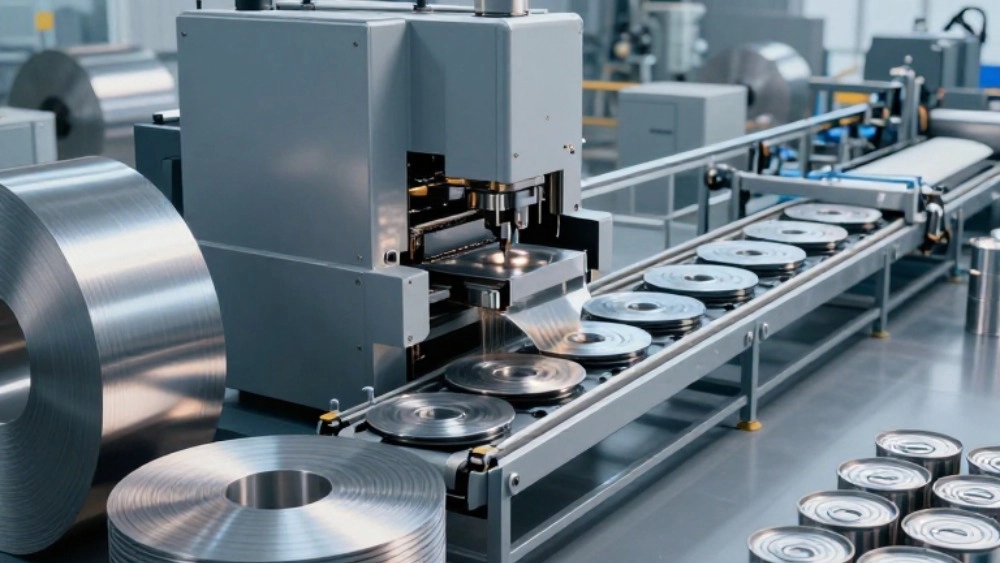
Can making industry is a complex engineering process, the accuracy of each step of which guarantees the quality and safety of the final product. In Javidan canning complex, all production steps are carried out according to international standards so that durable and defect-free products reach the consumer. In the following, we will examine the details of the canning process in four main stages.
First stage: material preparation and pre-production in canning
Each canning process begins with the careful selection of raw materials. Using low carbon steel sheets with tin coating (tin plate) is the first step. At this stage, the thickness of the sheet, the uniformity of the tin coating and the smoothness of the surface are carefully controlled to ensure the initial quality.
Then the following steps are taken:
- Cutting coils into sheets: after straightening, tin plate coils are cut into large sheets for the body, bottom and lid of the can.
- Internal varnishing: to prevent chemical reaction, the inner surface of the sheets is covered with resistant varnishes and baked in the oven.
- External printing and varnishing: the graphic design of the brand and product specifications are placed on the sheet with offset printing and then a protective varnish layer. It is applied to resist scratches and moisture.
- Body blank cutting: The printed sheets are cut into rectangular blanks according to the required dimensions to prepare for forming.
Second stage: shaping and metallurgical operations in can making
At this stage, the flat sheets are transformed into a cylindrical structure, which is the core of every product in the canning industry.
- Cylindrical forming: rectangular blanks are rolled in the forming machine and the cylindrical body of the can is formed.
- Longitudinal seam welding: the two edges of the body are connected by resistance welding or fusion. At this stage, the strength of the seam is carefully controlled to prevent any leakage.
- Varnishing on the welding seam: To prevent corrosion at the joint, the welding seams are covered with repair varnish and re-baked.
- Body beading: Reinforcing grooves (willow) are created on the body to increase resistance to impact and pressure.
- Flanging: The upper and lower edges of the body are given form. are ready to be connected to the lid and bottom of the can.
The third stage: making side parts and final assembly of the can
Completing a product in the canning industry requires accurate production of complementary parts and connecting them to the body.
- Manufacturing of the bottom disk and door rim: The bottom disk and door rims are punched from tin plate sheets and given a shape with special molds.
- Varnishing of parts: The inner surface of the bottom and rims are varnished and baked to prevent direct color contact with the metal. A double edge is created to achieve complete sealing.
- Sealing of rim and body: The rim of the door is also sealed on the upper flange of the body in the same way so that the opening of the can is ready for the installation of the lid.
The fourth stage: quality control, final tests and canning logistics
The last and most vital part in the immortal canning complex is to ensure zero production errors.
- Initial and final leakage test: the cans are tested using air or gas pressure to identify and isolate any leakage or defects in the seams.
- Earring and handle installation: special holes are punched on the body and wire handles are installed with a suitable cover for ease of transportation. The accuracy of measurement is controlled.
- Packing and shipping: empty cans are arranged on pallets, closed with stretch film and sent to paint factories with identification labels (batch number and production date).
Finally, in the paint factory, the cans are filled and the final caps are installed on them so that the product is ready for distribution in the market. Expertise in each of these steps is the distinguishing feature of Yavidan canning products in today's competitive market.